Why Mounting Amazon S3 on macOS Is a Smart Move
Using Windows instead? See our guide to mount an S3 bucket as a local drive on Windows.
Working directly on Amazon S3 buckets through Finder is far less painful than juggling the AWS CLI, the S3 console, and a folder full of half-downloaded objects. A mounted drive streams files on demand, so you can browse a terabyte-scale bucket without filling your Mac's SSD. And because the mount is just a folder, every macOS app — Preview, Pages, VS Code, Photoshop — sees S3 as a native location.
- 🧩 Native Finder Integration — Your Amazon S3 bucket shows up as a regular folder and a mounted Finder volume, so any macOS app can open and save into it without the AWS CLI or a third-party S3 browser.
- 💾 No SSD Hostage Situation — S3 buckets routinely hold terabytes. Mounting streams files on demand, so even a multi-TB bucket only spends Mac disk space on the files you actually open.
- ⚡ Real-Time Access to Cloud Files — Objects uploaded from a Lambda, EC2 instance, or another teammate appear in your mounted folder after the next poll cycle — no need to refresh the S3 console.
- 🛡️ Read-Only Mode for Safety — S3 buckets often hold production or compliance data. Mount read-only and Finder will block any accidental writes or deletes outright.
- 🌍 11 Nines of Durability, Global Reach — Amazon S3 offers multiple storage classes (Standard, Intelligent-Tiering, One Zone-IA, Glacier) across 30+ AWS regions. Pair that with OurClone's mount and you get a Finder folder backed by the most battle-tested object store on the planet.
How Mounting a Cloud Drive Works (and Why It's Different from Sync)
Traditional sync tools — including aws s3 sync — copy every object in your bucket down to your hard disk and keep both sides matched. That's fine for a small bucket, but it's a non-starter when you have terabytes of objects or pay-per-GB egress to worry about.
Mounting flips the model. OurClone presents your Amazon S3 bucket as a virtual filesystem — the object key hierarchy is visible right away, but file contents are only fetched when you actually open something. Frequently used objects are cached locally for instant repeat access, and writes are pushed back to S3 in the background using standard PUT requests.
OurClone makes both the polling interval (how often it checks S3 for remote changes) and the maximum cache size configurable, plus a read-only switch when you want extra protection against accidental writes — particularly handy for production buckets.
- 🚀 Stream files on demand — no need to download the whole drive
- 💾 Saves Mac disk space by caching only what you actually open
- 🔁 Two-way sync — edits in the mounted folder push back to Amazon S3
- 🛡️ Read-only mode prevents accidental writes when you only need to browse
What to Know Before You Mount Amazon S3
A few minutes of planning before you click Mount will save you from cleaning up a messy mount point — or worse, from racking up surprise S3 API charges.
- 📁 Pick the Right Mount Source — You can mount a specific bucket prefix (say
/projects/2026) for focused access, or mount the bucket root for full Finder browsing. A narrower prefix usually feels snappier and keeps API costs lower. - 🖥️ Choose a Sensible Local Mount Point — Use a dedicated, empty folder like
~/CloudMounts/S3. Don't aim it at your Desktop or any folder that already has files — the mount will hide whatever was there. - 🔒 Read-Only vs Read-Write — Read-only is the safer pick for production buckets or shared compliance data. Pick read-write only if you need to upload, rename, or delete. Remember: read-only mode literally cannot upload — Save dialogs will fail.
- ⏱️ Set a Reasonable Polling Interval — Lower intervals catch remote changes faster but rack up LIST calls (which cost money on S3). 30–60 seconds is a sensible balance; bump it higher for big buckets to keep your AWS bill in check.
- 💽 Plan Your Cache Size — A bigger cache makes repeat opens snappy and avoids paying S3 GET costs over and over. A few GB is enough for documents; bump it up if you regularly reopen video or large datasets.
How to Mount Amazon S3 on macOS with OurClone
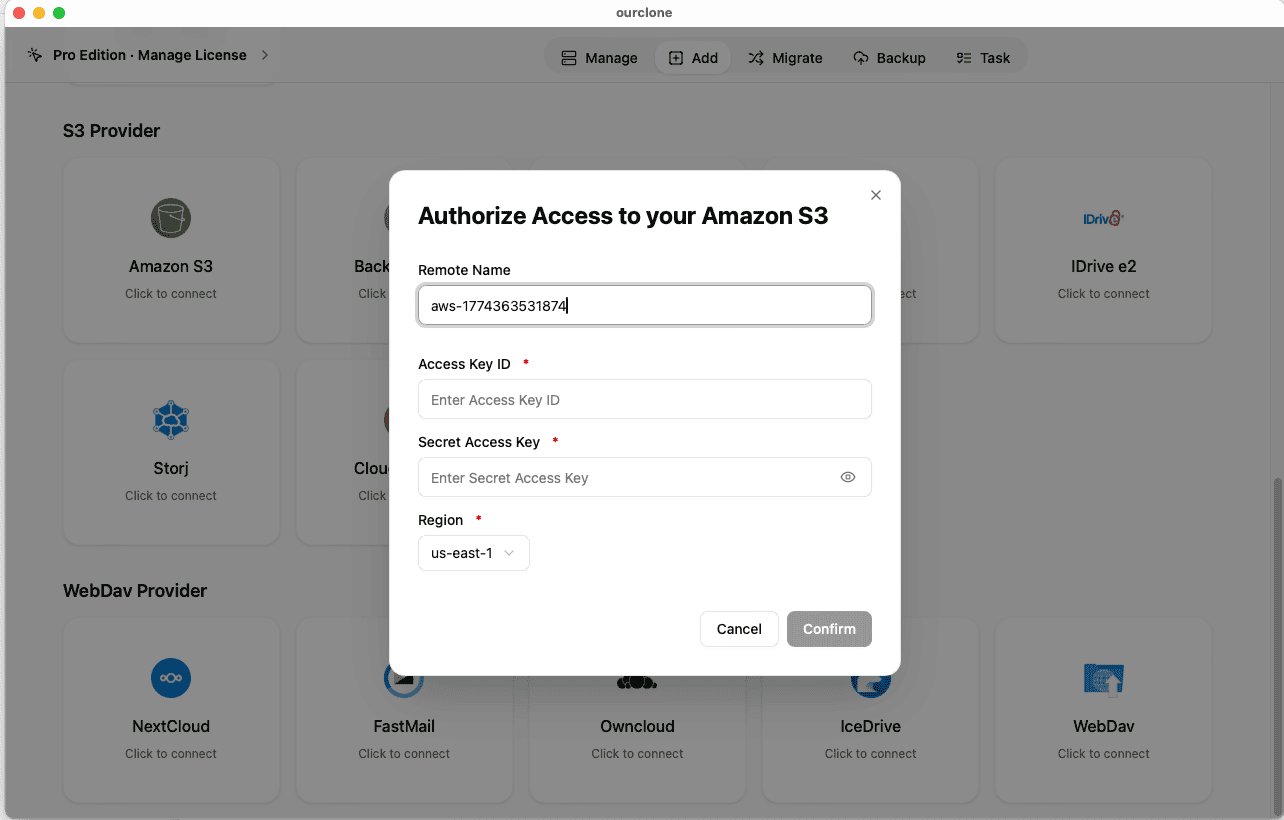
OurClone makes mounting Amazon S3 on macOS refreshingly painless. Step 1 uses AWS Access Keys — no AWS CLI, no Identity Center login, just paste in an IAM user's keys — and from there you're four clicks away from a Finder-ready volume.
- 🔐 Connect to Amazon S3 via Access Keys — Open OurClone and go to
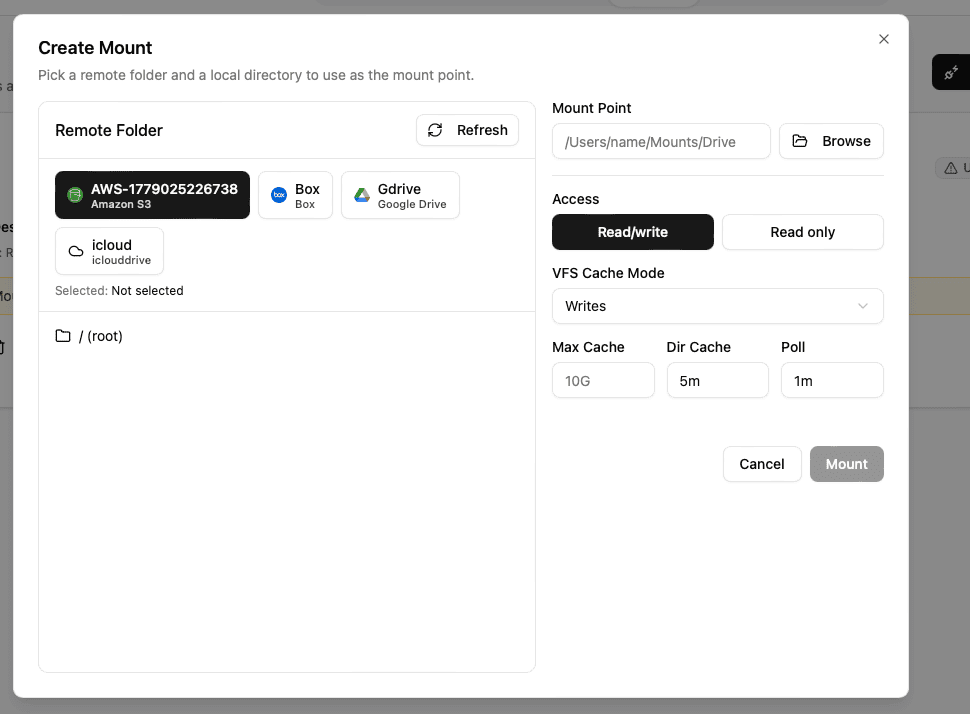
Add Storage. Choose the Amazon S3 provider from the S3 list, then fill in your Remote Name, Access Key ID and Secret Access Key (create these in the AWS IAM console — best practice is a dedicated IAM user with an S3-only policy, not your root account). Pick the Region your bucket lives in (defaultus-east-1). Once entered, OurClone will verify your credentials and Amazon S3 will appear as a connected storage backend. - 📂 Open the Mount Tab and Click New Mount — Once Amazon S3 is connected, go to the
Mounttab in OurClone. Click the New Mount button in the top-right corner to open the mount configuration dialog. - ⚙️ Configure the Mount Settings — In the dialog, pick Amazon S3 as the authorized source. Choose what to mount — a specific bucket prefix (e.g.,
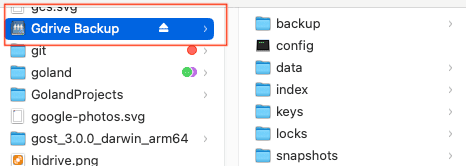
/projects/2026) or the entire bucket. Then pick a local folder as the mount point (something like~/CloudMounts/S3). Choose Read-only if you just want to browse, or Read-write if you need to upload and edit. Optionally tweak the polling interval (how often OurClone checks S3 for changes) and max cache size. Click Mount to finish. - 🗂️ Use Your Amazon S3 Mount Like a Local Folder — Open the local folder you picked as the mount point. macOS now treats it as a mounted volume — you can browse, open, create folders, drag in files, and delete items just like any local folder. For example, create a new
backupfolder inside and drop in a few photos. OurClone uploads them to your S3 bucket in the background as standard objects. - ✅ Confirm the Sync on Amazon S3 — Switch back to OurClone and open your Amazon S3 storage from the file browser — your new
backupfolder and uploaded photos should already be listed. For extra peace of mind, log in to the AWS S3 console and confirm the objects appeared in your bucket too.
The combination of AWS IAM access keys and OurClone's mount engine gives you an Amazon S3 bucket that genuinely feels like a local volume on macOS — no CLI, no full-bucket downloads, just objects where you expect them.
Getting the Most Out of Your Amazon S3 Mount
A live mount is convenient, but S3's pay-per-request pricing rewards a little tuning. Keep these in mind once your Amazon S3 mount is up and running.
- 🔁 Edits Sync Both Ways — Anything you add, rename, or delete in the mounted folder propagates to Amazon S3. Changes uploaded from other clients appear after the next poll cycle.
- 🛑 Read-Only Means Read-Only — If you mounted with read-only permissions, drag-and-drop uploads and Save dialogs will fail silently or with a permissions error. Remount as read-write to enable uploads.
- 💽 Cache Lives on Your Mac — Recently opened files are cached locally to avoid repeated S3 GET requests. If your Mac is low on disk space, reduce the max cache size in the mount settings.
- ⏱️ Polling Interval Affects Freshness (and Cost) — A short polling interval picks up remote changes faster but rings up more LIST calls. For Amazon S3, a 30–60 second interval is usually a good balance between freshness and cost.
- 🔌 Unmount Cleanly Before Sleep — If you put your Mac to sleep with the mount active, OurClone will reconnect automatically on wake. For long absences, click Unmount in the Mount tab to release the volume.
When Your Mount Stops Working
Most mount failures trace back to one of a few causes: rotated IAM access keys (AWS strongly encourages periodic rotation, and the old keys stop working the moment you deactivate them), a tightened bucket policy that no longer permits your IAM user, a wrong region in the Add Storage form, or a mount point that's no longer empty. If your Amazon S3 mount returns AccessDenied or 403 errors, regenerate keys in the IAM console, update them under Add Storage, and remount.
Verify the Sync Anytime
Any time you're unsure whether an object made it up, you have two easy checks: open the Amazon S3 storage view inside OurClone's file browser, or log straight into the AWS S3 console and inspect the bucket. Whatever Finder shows in your mount point should match — and if it doesn't, give it a poll cycle and check again.