What Is Backblaze?
Backblaze provides cloud backup and cloud storage products. In OurClone, Backblaze-compatible storage can be used for transfer, sync, encrypted backups, and mounting when connected with the required credentials.
Official website: https://www.backblaze.com/
- Useful for users already storing backup data with Backblaze services.
- Best paired with clear bucket or folder organization.
- OurClone backup repositories add an encrypted snapshot layer on top of remote storage.
What OurClone Supports for Backblaze
| Operation | How it works in OurClone |
|---|---|
| Sync | Keep a folder on Backblaze synchronized with another cloud storage account or a local folder. OurClone compares file changes and updates only what needs to change. |
| Transfer | Copy or move files between Backblaze, your Mac, and other connected cloud providers. Transfers run through your local computer, so you stay in control of the data path. |
| Backup | Create an encrypted backup repository on Backblaze, then save snapshots of local folders. Later snapshots are incremental, so unchanged files do not need to be uploaded again. |
| Mount | Mount Backblaze as a local directory in macOS or Windows, then browse and manage remote files from the operating system file manager. |
Backblaze Upload and Download Limits
These limits come from the storage provider or protocol, not from OurClone. OurClone still has to respect provider file-size caps, API quotas, bandwidth rules, account storage quota, and server-side throttling.
| Upload limits | Backblaze Computer Backup states it does not have default file size restrictions, and files larger than 100 MB are chunked for upload. Backblaze B2 cloud storage has its own object limits. |
| Download limits | Downloads depend on the Backblaze product, restore method, and selected archive/snapshot workflow. Large restores may be packaged or handled through B2-compatible tools. |
| OurClone tip | Confirm whether your OurClone connection targets Backblaze B2-style storage or another Backblaze product, then follow that product’s limits. |
How to Add Backblaze in OurClone
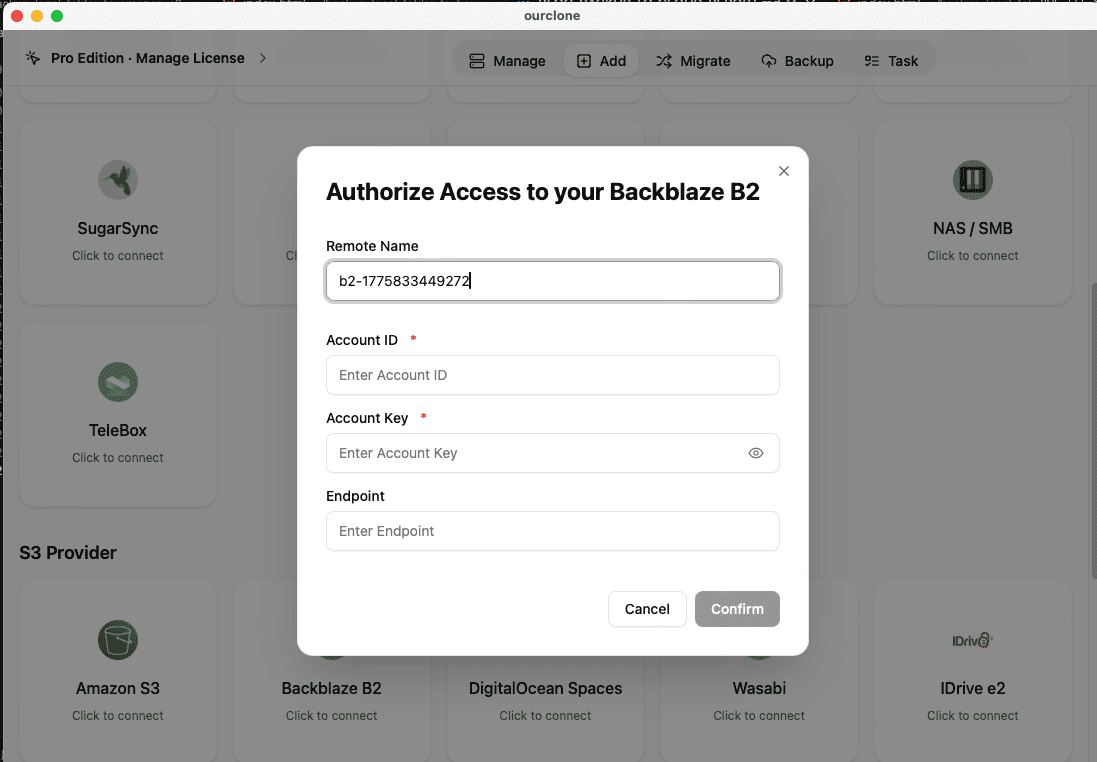
Backblaze connects through S3-compatible access keys in OurClone.
- Sign in to the Backblaze console.
- Create or locate an Access Key ID and Secret Access Key for the bucket you want OurClone to use.
- Use the Backblaze storage credentials shown for your account or bucket.
- Open OurClone, click Add Storage, select Backblaze, enter the credentials, and connect.
Sync and Transfer Workflow
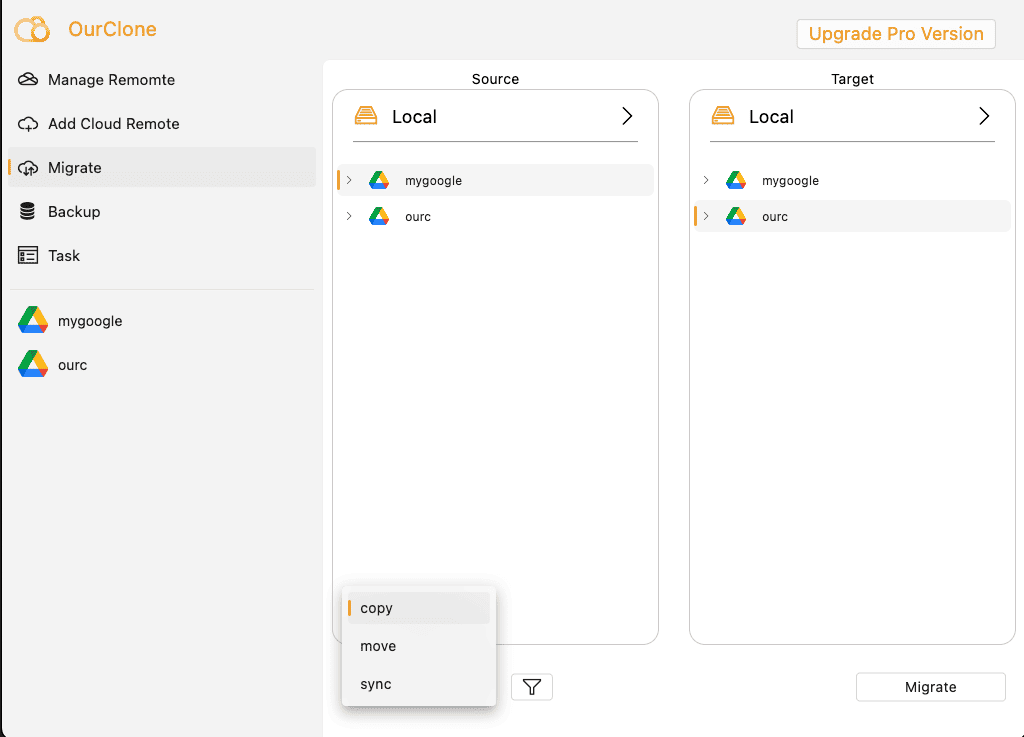
After Backblaze is connected, open the Migrate area in OurClone. Choose Backblaze as the source or destination, select the folders you want to work with, then choose the task mode.
- Copy duplicates files while keeping the source unchanged.
- Move transfers files and removes them from the source after completion.
- Sync keeps the destination aligned with the source folder.
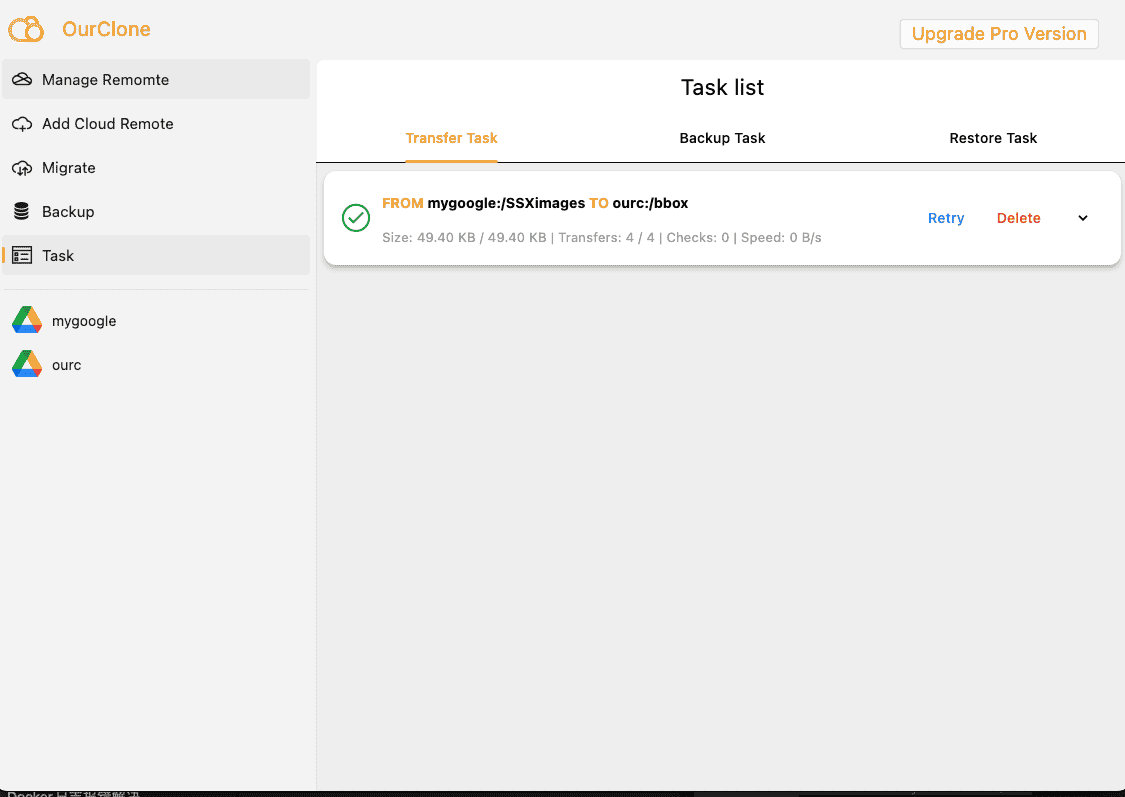
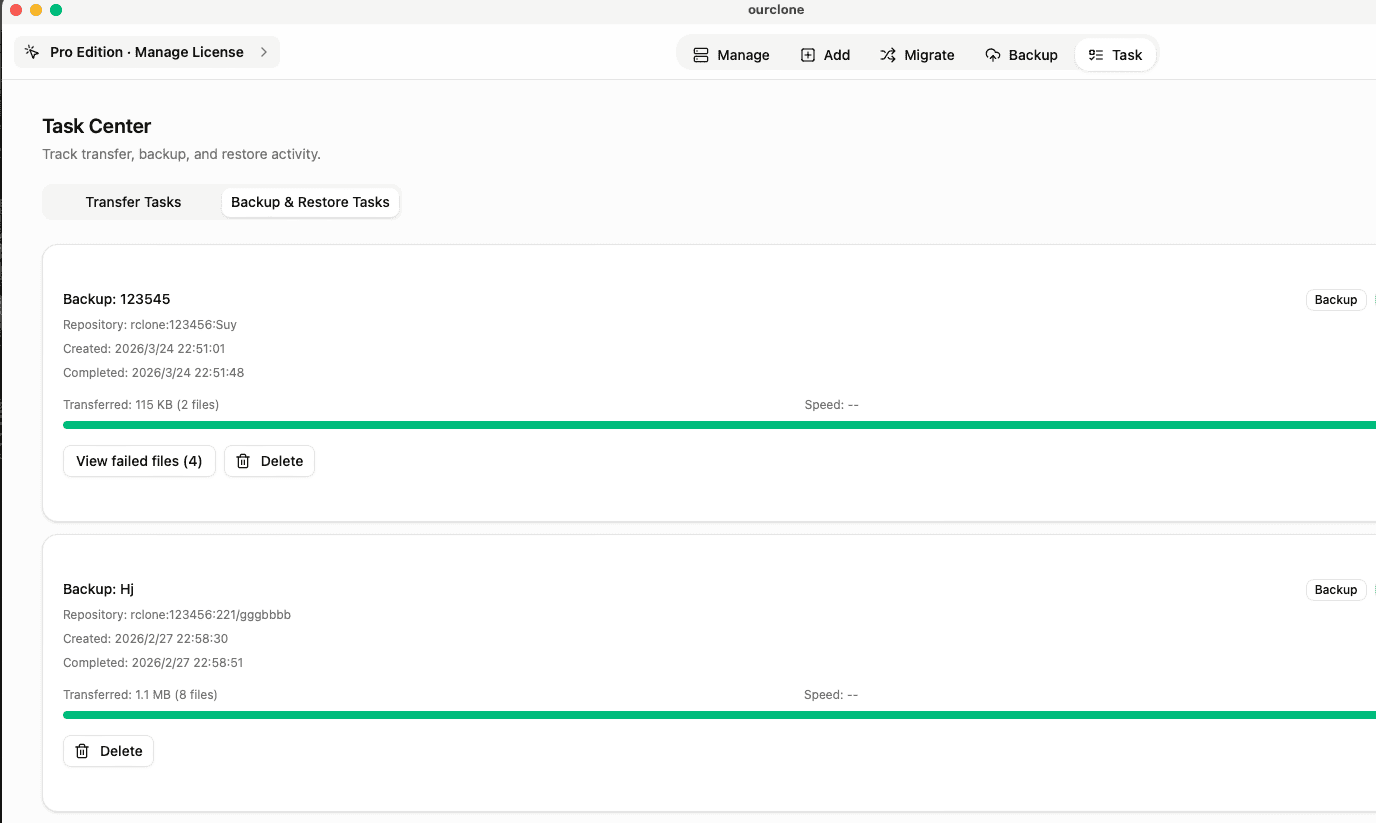
Task progress is visible in the Task tab, including completed, skipped, and failed files.
Backup Workflow
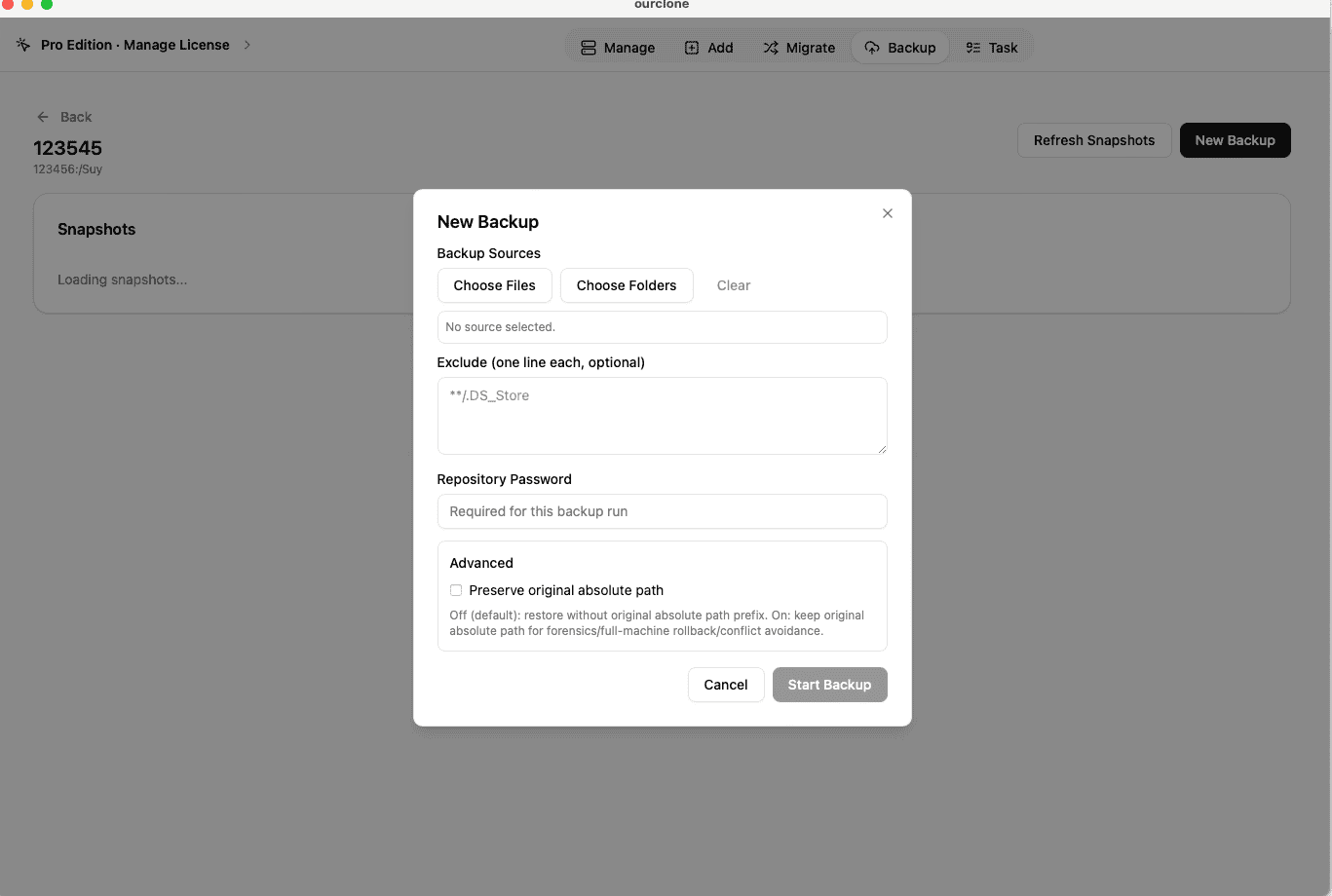
For backups, first create a backup repository on Backblaze. A repository needs a name, a storage path, and an encryption password. Keep this password safe because it is required for both future snapshots and restores.
- Open Backup and create or choose a repository on Backblaze.
- Open the repository and click New Backup.
- Select local folders such as
~/Documents,~/Pictures, or a project folder. - Start the snapshot. The first run uploads the full selection; later runs are incremental.
- Use Restore from a backup record when you need to recover files to a local directory.
Mount Backblaze as a Local Folder
OurClone can mount Backblaze as a local operating-system directory. This is useful when you want to browse cloud files in Finder or File Explorer, open files from desktop apps, or copy files with the same habits you use for local folders.
- Open the mount area in OurClone and select your connected Backblaze account.
- Choose the remote path you want to expose locally.
- Pick a local mount point, then start the mount.
- When finished, unmount cleanly from OurClone before disconnecting your network or shutting down.
Best Practices for Backblaze
- Use a clear folder naming convention such as
/ourclone-backups,/sync, or/archive. - Confirm that your Backblaze account has enough storage before running a large migration or backup.
- Run a small test sync or restore before relying on a new workflow for important files.
- For large first-time jobs, keep your computer awake and connected to a stable network.
- If authentication fails later, reconnect the account or refresh the token before restarting the task.
Backblaze Tutorial Cluster
This Backblaze pillar page connects the main provider overview with practical OurClone guides. Use these supporting articles when you want to transfer, sync, back up, or mount Backblaze without changing the existing guide URLs.
How to Back Up Your Mac to Backblaze B2: A Real-World Guide That Works
Learn how to reliably back up your macOS folders to Backblaze B2 using OurClone with encrypted, incremental backups -- no tech jargon, just practical steps.
How to Back Up Your Mac to Backblaze: A Practical Guide That Works
Learn how to reliably back up your macOS folders to Backblaze using OurClone with encrypted, incremental backups -- no tech jargon, just practical steps.
Mount Backblaze B2 as a Local Drive on Mac: The Easy Way with OurClone
Learn how to mount Backblaze B2 as a local drive on macOS using OurClone — browse, edit and upload cloud files as if they live on your Mac.
Getting Started: How to Transfer Files Between Cloud Storages Using OurClone
Learn how to efficiently and securely transfer data from one cloud provider to another using OurClone on your local machine.
Use Backblaze from a desktop app
OurClone lets you connect Backblaze once, then use it for local-first sync, transfer, mount, and encrypted backup workflows.
The macOS download is for Apple Silicon (M1 or later). Using an Intel Mac? Download the Intel version