Why Mounting Linode Object Storage on macOS Is a Smart Move
Linode Object Storage is the S3-compatible storage tier of Linode, now part of Akamai's cloud platform. It usually lives behind consoles, s3cmd, and API calls -- fine for deploy scripts, less fine for a person who just wants to drop a file into a bucket. Mounting it with OurClone puts your buckets straight into Finder.
- 🗂️ Buckets in Finder -- Browse Linode buckets and prefixes as normal macOS folders from any app.
- 💾 No Full Download Required -- Stream only the objects you open instead of pulling entire buckets to disk.
- 🔁 Live Two-Way Access -- Files dropped into the mount upload to the bucket; new objects appear after the next poll.
- 🛡️ Read-Only Safety -- Mount a production assets bucket read-only so a stray drag-and-drop can't overwrite anything.
- 🧰 No Extra Tooling -- Skip s3cmd, rclone configs, and one-off scripts for everyday file chores; keep them for automation.
How Mounting Object Storage Works (and Why It's Different from Sync)
Sync downloads every object to your Mac and keeps both ends matched. A mount leaves objects in your Linode bucket and streams them to your Mac only when you open them.
OurClone handles reads, writes, and change detection through a local cache, keeping recently used files fast while the rest stays in the bucket until needed.
Because this is object storage, every listing and download is an S3 API request against your cluster. Mounting a specific bucket or prefix keeps request volume sensible, and the polling interval controls how often OurClone checks for remote changes.
- 🚀 Stream objects on demand -- no need to download whole buckets
- 💾 Saves Mac disk space by caching only what you actually open
- 🔁 Two-way access -- files added to the mounted folder upload to the bucket
- 🛡️ Read-only mode prevents accidental writes to production data
What to Know Before You Mount Linode Object Storage
Plan these before mounting.
- 🧩 No macFUSE Required -- On macOS, OurClone mounts through rclone's built-in
nfsmount, which relies on the NFS client already in macOS, so there is no kernel extension to install before your first mount. - 🔑 Create an Access Key -- Generate an access key pair under Object Storage in Linode Cloud Manager. OurClone needs the Access Key ID and Secret Access Key; the endpoint is optional, but if the connection fails, fill in your bucket's regional endpoint (shown in the bucket details).
- 🪣 Pick a Bucket or Prefix -- Mount a single bucket, or a prefix inside it, rather than everything at once; it keeps Finder listings fast and API requests low.
- 🖥️ Choose a Sensible Mount Point -- Use a dedicated empty folder like
~/CloudMounts/LinodeObjectStorage, not your Desktop or a populated folder. - 🔒 Read-Only vs Read-Write -- Read-only suits browsing backups and assets; read-write is needed to upload, edit, or delete objects.
- 💽 Plan Your Cache Size -- A larger cache speeds repeat access but uses local disk; size it to the files you open most.
How to Mount Linode Object Storage on macOS with OurClone
OurClone connects to Linode Object Storage with an access key pair, then mounts a bucket as a local volume.
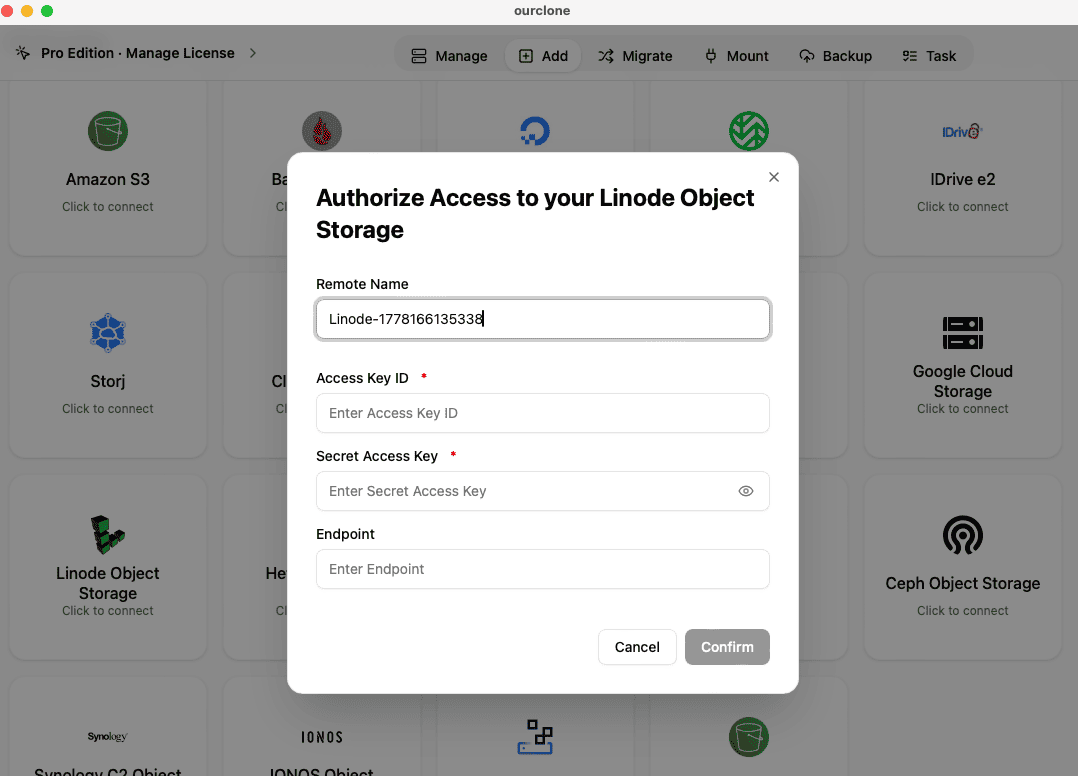
- 🔐 Connect Linode Object Storage via Access Keys -- Log in to Linode Cloud Manager, open Object Storage, and create a new access key under Access Keys. Then open OurClone, go to
Add Storage, select Linode Object Storage in the S3 provider list, confirm the Remote Name, and enter your Access Key ID and Secret Access Key. If the connection fails, add your bucket's regional endpoint as well. - 📂 Open the Mount Tab and Click New Mount -- With Linode connected, go to the
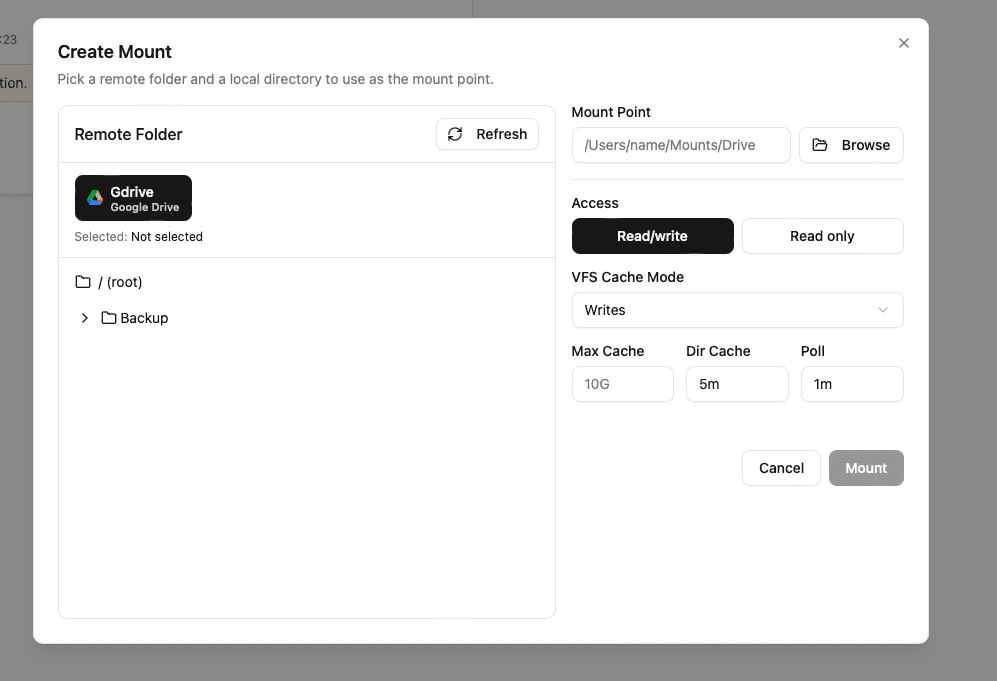
Mounttab and click New Mount in the top-right corner. - ⚙️ Configure the Mount Settings -- Pick Linode Object Storage as the source. Choose the bucket (or a folder inside it), then a local mount point like
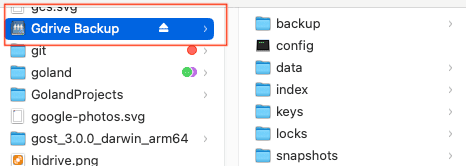
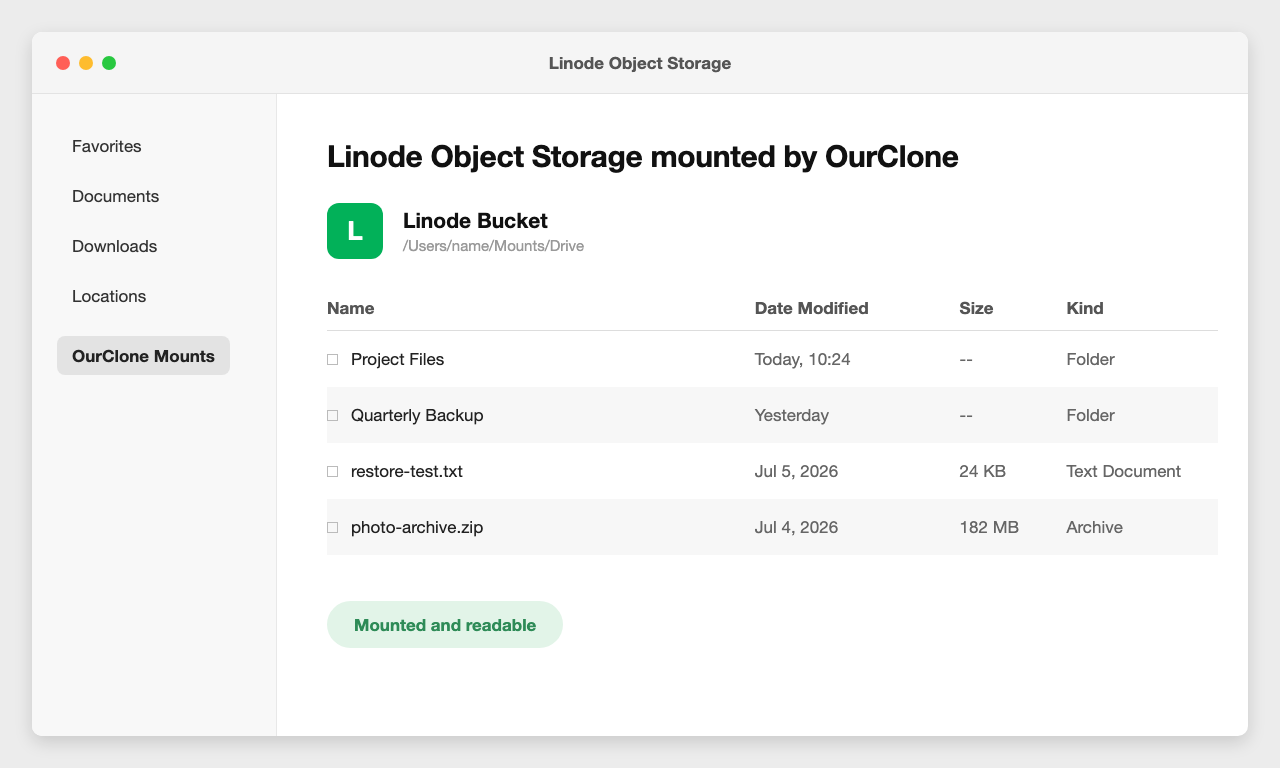
~/CloudMounts/LinodeObjectStorage. Select Read-only or Read-write, optionally adjust polling interval and max cache size, and click Mount. - 🗂️ Use Your Bucket Like a Local Folder -- Open the mount point in Finder. It behaves as a mounted volume -- browse, open, create folders, drag in files, and delete items. Add a
backupfolder and a few files; OurClone streams them to the bucket in the background. - ✅ Confirm the Upload on Linode -- Back in OurClone, open the Linode storage in the file browser to see the new
backupfolder. For extra certainty, open the bucket in Linode Cloud Manager and confirm the objects arrived.

An access key pair plus OurClone's mount engine turns a Linode bucket into a native-feeling folder on macOS.
Getting the Most Out of Your Linode Object Storage Mount
Keep these in mind once your Linode mount is live.
- 🔁 Edits Sync Both Ways -- Adds, renames, and deletes in the mount push to the bucket; objects uploaded by your apps or scripts appear after the next poll cycle.
- 🛑 Read-Only Means Read-Only -- A read-only mount blocks uploads and saves. Remount read-write to make changes.
- 💽 Cache Lives on Your Mac -- Recently opened objects are cached locally; lower the max cache size if disk space is tight.
- ⏱️ Polling Interval Affects Freshness and Requests -- Every poll lists the bucket via the S3 API. A longer interval means fewer requests; a shorter one means fresher listings.
- 🔌 Unmount Cleanly Before Sleep -- OurClone reconnects on wake; for long breaks, click Unmount to release the volume.
When Your Mount Stops Working
Linode mounts usually break when an access key is revoked, the bucket's region and the configured endpoint no longer match, the network drops, or the mount point is no longer empty. Check the key in Cloud Manager, set the bucket's regional endpoint explicitly in the connection, and remount.
Verify the Sync Anytime
When in doubt, open the Linode storage view inside OurClone or check the bucket in Linode Cloud Manager to confirm your objects.