Google Cloud Storage as a Backup Home for Your Mac
Google Cloud Storage is the kind of backup target you reach for when "good enough" is not good enough. You get hyperscale durability, multiple storage classes, region and multi-region buckets, and lifecycle rules that the bucket itself enforces -- and OurClone makes it possible to use all of that from a Mac without writing a single shell script.
- 🌍 Choose Your Geography -- Single-region for low latency, dual-region for resilience, or multi-region for global durability. Pick the bucket location that matches the value of the data instead of taking whatever default you are given.
- 💎 Storage Classes That Match the Use Case -- Standard for hot working backups, Nearline or Coldline for archives, Archive for the snapshots you really hope you never need. The bucket can host them all under one prefix.
- 🔧 S3 Compatibility via HMAC -- Google Cloud Storage exposes an S3-compatible interface using HMAC keys, which is exactly what OurClone needs to treat it like any other S3 backend.
- 🔐 Two Layers of Protection -- Google Cloud Storage encrypts objects on its side, and OurClone encrypts the repository on your Mac before upload. Even an admin browsing bucket contents only sees opaque encrypted objects.
- 📜 Bucket Lifecycle Rules Stay With You -- Versioning, retention, and lifecycle transitions are configured on the GCS bucket itself, so they keep working regardless of which client is writing into the prefix OurClone owns.
Why Incremental Snapshots Pay Off on Google Cloud Storage
Hyperscale object storage is durable, but every gigabyte you upload is still bandwidth and storage you pay for. Re-uploading the same RAW photo library or project tree every night to Google Cloud Storage adds up quickly with very little upside.
OurClone runs the first snapshot in full and then transfers only changed data on later runs. The bucket grows roughly in line with the new content you actually create, not with daily duplicates of files that have not changed in months.
Smaller incremental snapshots also play nicely with GCS storage classes -- you can let lifecycle rules age old snapshots into Nearline or Coldline without your active backup window ever having to touch the cold tiers.
- 🚀 Cuts upload time on every run after the first snapshot
- 💾 Keeps the GCS bucket from filling up with redundant data
- 🔐 Each incremental snapshot still goes through the encrypted repository
- 📅 Lets you restore a folder as it looked at a specific previous run
Set Up the Google Cloud Storage Side First
A few minutes inside the GCS console up front saves a lot of debugging later. The most important thing to get right is the credential type.
- 🔑 Use HMAC Keys, Not a Service-Account JSON -- OurClone connects to Google Cloud Storage through the Interoperability interface, which expects an Access Key ID and Secret Access Key. A service-account JSON key cannot be pasted into the S3 fields. Generate the HMAC key in
Cloud Storage->Settings->Interoperability. - 🪣 Create or Choose a Bucket With the Right Location -- Pick the bucket that will host your Mac backup repository, and confirm its location and storage class. A multi-region bucket adds geographic resilience; a regional bucket usually costs less.
- 🧑🔧 Scope the Service Account -- HMAC keys are issued for a service account. Limit that service account to just the bucket and operations the backup actually needs -- a least-privilege key is much safer than a project-wide one.
- 📁 Pick the Right Folders on Your Mac -- Focus on folders with real recovery value:
~/Documents,~/Pictures, code projects, and external drives. Skip caches and ephemeral build outputs that bloat the upload without adding restore value. - 🧪 Start With a Small Test Folder -- Run the first OurClone snapshot against a small folder to confirm the HMAC keys, the bucket path, and the restore flow before you commit a multi-gigabyte archive to GCS.
Backing Up macOS Folders to Google Cloud Storage With OurClone
With HMAC keys ready and a bucket chosen, the rest happens entirely inside OurClone. Five steps walk you from connecting GCS to restoring a file.
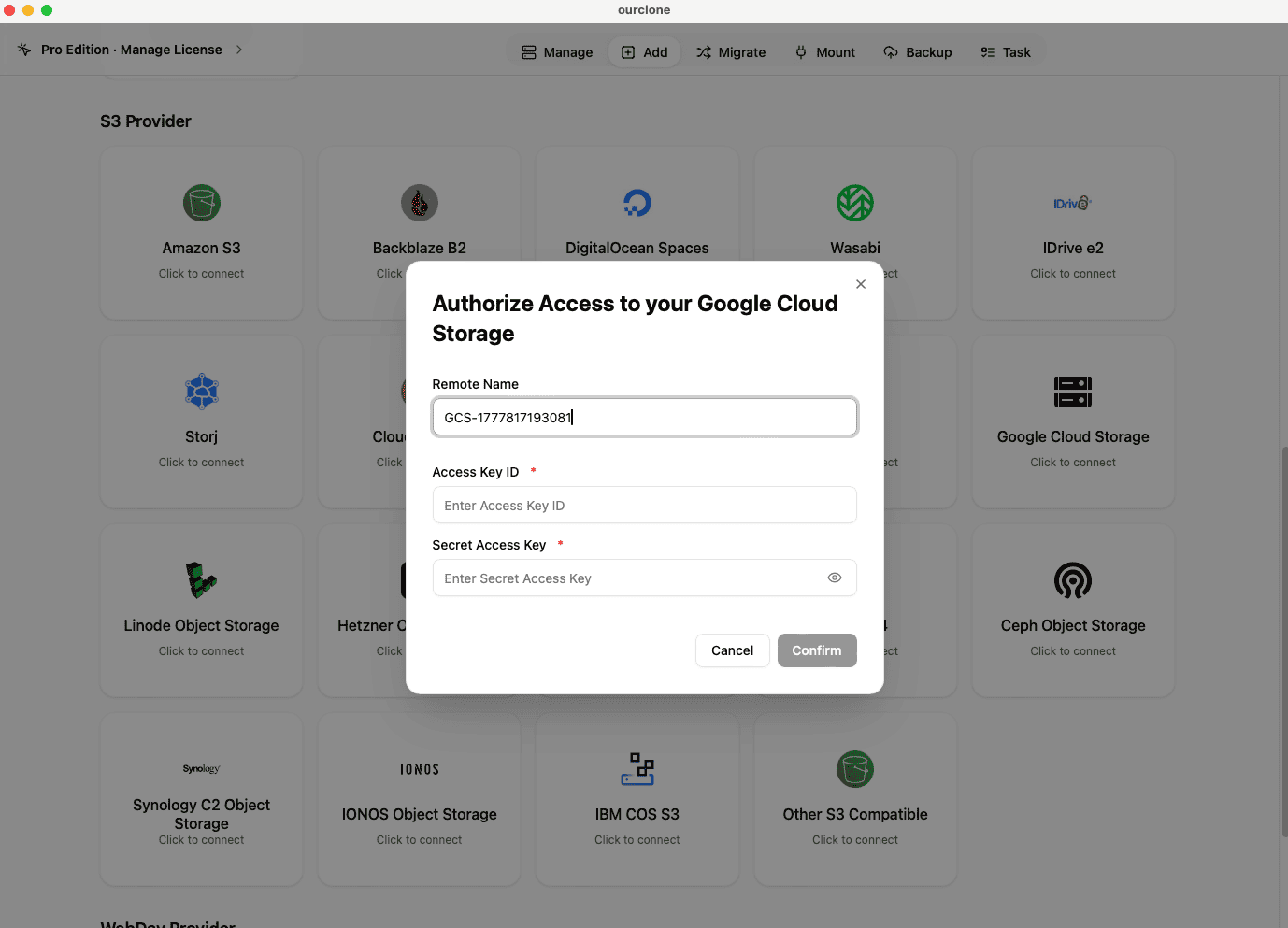
- 🔗 Add Google Cloud Storage in Add Storage -- In OurClone, open
Add Storageand select Google Cloud Storage. Give the connection a custom name like "GCS -- Mac Backup", then paste your HMAC Access Key ID and Secret Access Key. OurClone uses the GCS provider profile, so you do not need to configure a separate endpoint. Save to add it to your storage list. - 📦 Create a Backup Repository in Your GCS Bucket -- Open the
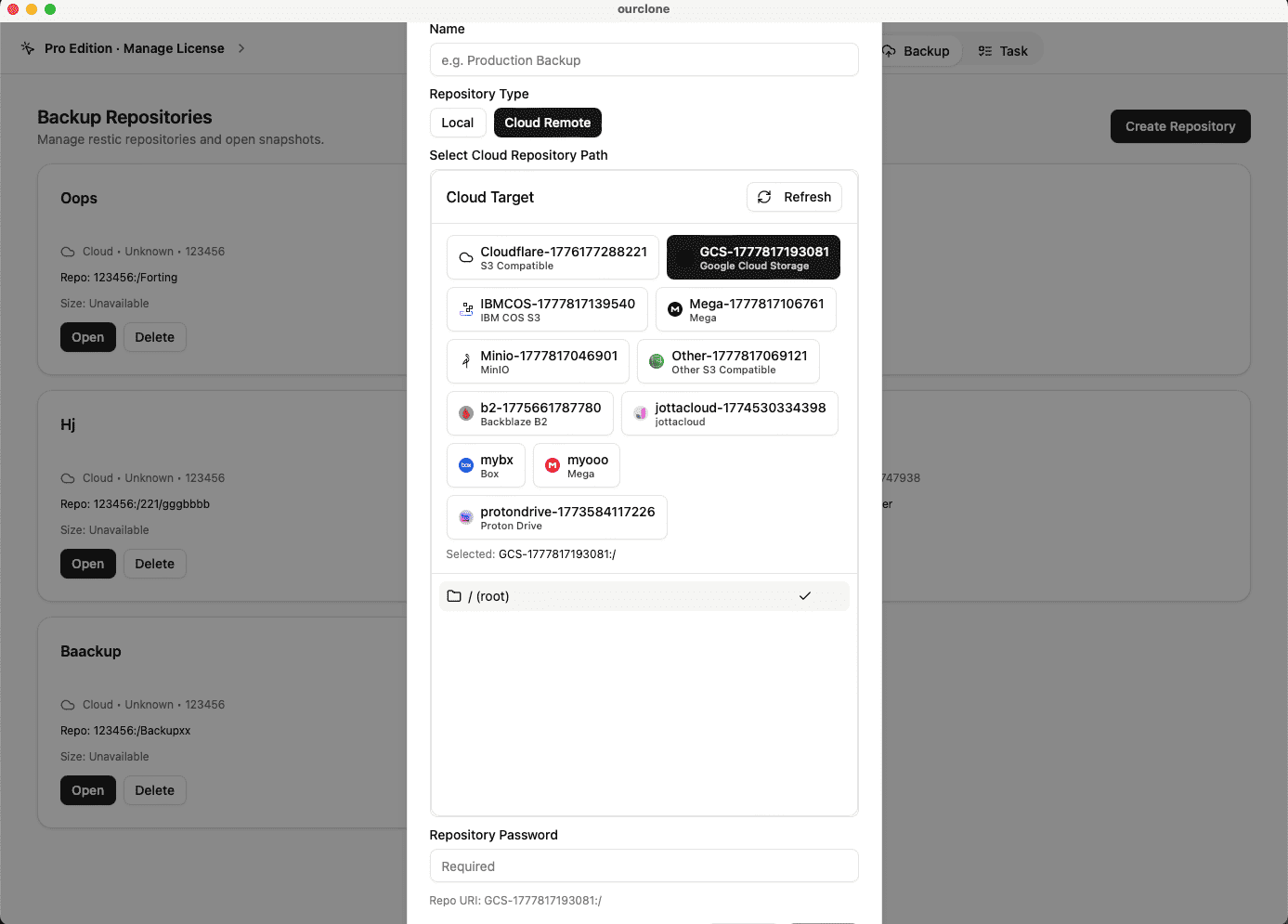
Backuptab and create a new repository. Choose your Google Cloud Storage connection as the destination, point it at a path inside your bucket (for examplemac-backup/laptop), give the repository a clear name, and set a strong repository password. That password encrypts the repository and is required for every snapshot and restore -- save it in a password manager. - 🗂️ Snapshot the Folders That Matter -- Open the new repository and create a snapshot. Pick macOS folders such as
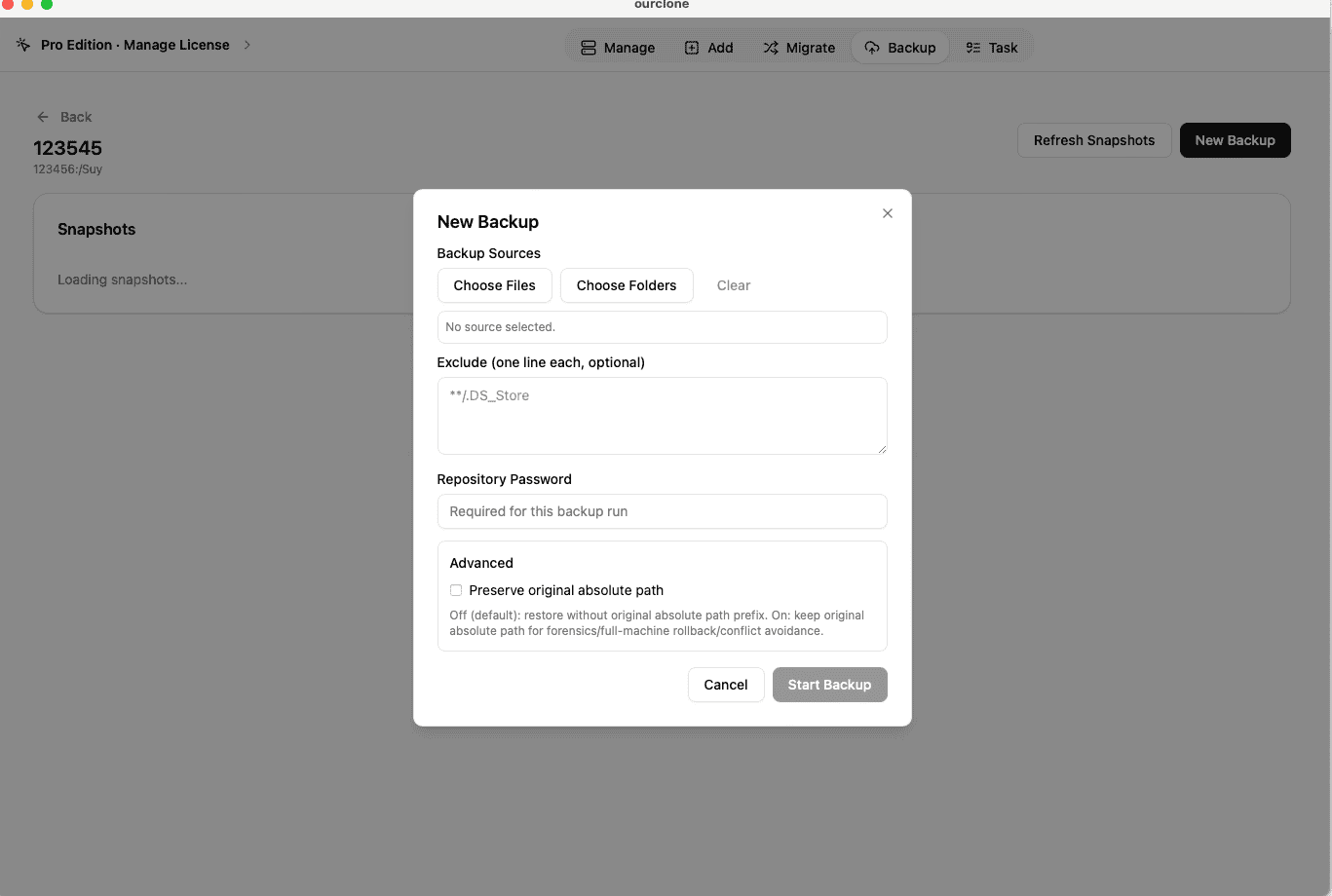
~/Documents,~/Pictures, or a project directory. OurClone packages, encrypts, and uploads the data into your GCS bucket. The first run is a full snapshot; later runs of the same folders are incremental. - 🕒 Watch It Run From Task -- Backup & Restore -- Open the
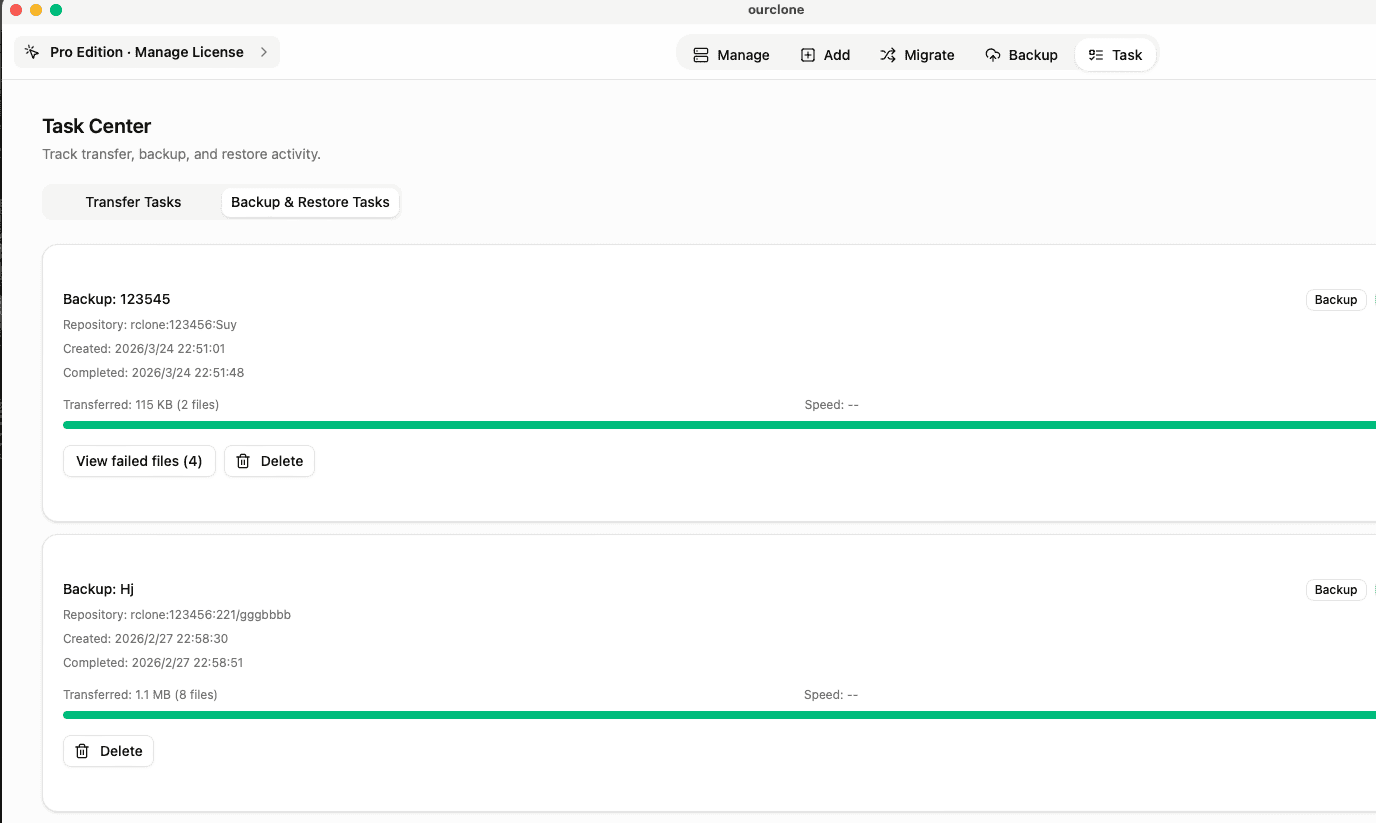
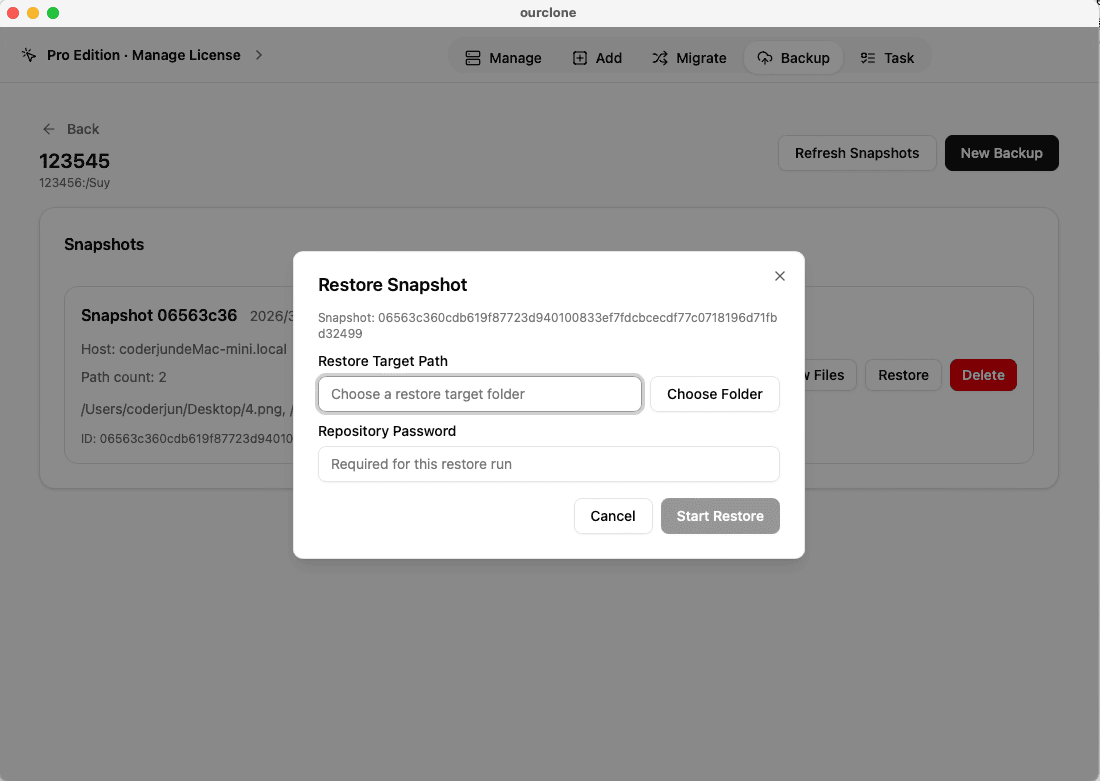
Tasktab and switch toBackup & Restore. The active Google Cloud Storage backup task shows progress, throughput, and any warnings. Chunked uploads keep the snapshot moving even when the connection is not perfectly stable. - 🔁 Restore From a Snapshot -- In the GCS repository, open the snapshot you want, click
Restore, enter the repository password, and choose a local destination on your Mac. OurClone decrypts the data and writes the files back. You can restore one folder, a subset, or the whole snapshot.
Because OurClone treats Google Cloud Storage as an S3-compatible target with chunked uploads, even a large photo library survives an interrupted connection without restarting from zero.
Confirm Your Google Cloud Storage Backup and Keep It Healthy
A backup that runs but never gets checked is just a hopeful guess. A short routine turns your GCS backup into something you actually trust.
- 📄 Check Task Status After Each Run -- In
Task->Backup & Restore, confirm the latest Google Cloud Storage task finished cleanly. A clean completion is the first signal that the snapshot landed properly in the bucket. - 🧩 Read Skipped Files and Permission Warnings -- macOS sometimes blocks OurClone from reading specific files. The task log lists exactly which files were skipped, so you can grant Full Disk Access or move files out of a protected location and re-run.
- 📜 Inspect the Detailed Log -- Open a finished GCS task to see what was new, what was unchanged, and how much data the incremental run actually uploaded. That makes it easy to spot a folder that has unexpectedly grown.
- 🔐 Treat the Repository Password as Critical -- The Google Cloud Storage bucket only stores encrypted repository data. Without the repository password, even a project owner with full IAM access cannot restore. Store the password in a password manager.
Rotate HMAC Keys and Watch Bucket Permissions
HMAC keys can be rotated, deleted, or scoped down at any time, and IAM policies on the underlying service account can change without warning. If a backup task suddenly fails, the cause is often a key that was deactivated or a permission that was tightened. Generate a fresh HMAC key, paste it into OurClone, and the schedule resumes.
Run a Restore Drill Before You Need One
Pick a small folder from a recent Google Cloud Storage snapshot and restore it into a throwaway directory on your Mac. That single dry-run confirms the HMAC keys, the bucket path, the repository password, and the OurClone restore flow are all still working together -- which is what you really want to know before something actually goes wrong.