Why DigitalOcean Spaces Works as a Mac Backup Target
DigitalOcean Spaces is the kind of object storage you reach for when you already use the rest of the DigitalOcean ecosystem and want one less console to manage. For a developer or small team backing up a Mac, that familiarity matters -- the Spaces dashboard and key management sit right next to the Droplets you already log in to.
- 🌐 Regional Spaces, Regional Endpoints -- Each Space lives in a specific region with its own endpoint, so you can keep your Mac backup near you (NYC3, AMS3, SFO3, FRA1, SGP1) instead of shipping bytes across continents.
- 🛠️ Familiar S3 Tooling -- Spaces speaks the S3 API faithfully, so OurClone treats it like any other S3 backend -- access key, secret, endpoint, bucket path.
- 🔐 Encryption Before Upload -- OurClone encrypts the repository on your Mac with a password you set, so the bytes that land in your Space are already opaque.
- ♻️ Repositories You Can Split By Project -- Run one OurClone repository for client work and another for personal media inside the same Space, and let restores stay focused.
- 🍎 Mac-Native Workflow -- No CLI to install, no rclone config to hand-edit. OurClone runs on macOS and treats Spaces as a plain S3 destination for
~/Documents,~/Pictures, or external drive folders.
Why Incremental Snapshots Suit Spaces Pricing
Spaces bundles a generous amount of storage and bandwidth into its base plan, but every gigabyte you push past the included tier is bandwidth and storage you pay for. Re-uploading the same RAW photo library or project tree every night is wasted budget when most files have not changed.
OurClone runs the first snapshot in full, then sends only changed data on the runs that follow. Your Space grows roughly with the new content you actually produce, not with daily duplicates of yesterday's files.
For a regional Space, smaller incremental snapshots also mean shorter upload windows -- which makes overnight backups much friendlier to a shared home connection.
- 🚀 Cuts upload time on every run after the first snapshot
- 💾 Keeps Spaces usage from drifting past the included tier
- 🔐 Each incremental snapshot still goes through the encrypted repository
- 📅 Lets you walk back through snapshots and restore an older version
Get the Spaces Side Ready First
A short setup pass inside the DigitalOcean control panel saves you time later. The endpoint and the key scope are the two things to nail down up front.
- 🌍 Pick the Region and Note the Endpoint -- Each Spaces region has its own endpoint, formatted like
{region}.digitaloceanspaces.com(for examplenyc3.digitaloceanspaces.com). The endpoint is required in OurClone, and it must match the region of the Space you plan to use. - 🔑 Create a Backup-Only Spaces Key -- Generate a fresh Spaces access key under
API->Spaces Keysinstead of reusing one shared with your application code. A backup-only key can be rotated without touching anything else. - 📁 Pick the Right Folders -- Focus on folders that actually hurt to lose:
~/Documents,~/Pictures, code projects, and external drive folders. Skip caches and generated build output that bloat the upload without adding restore value. - 📶 Plan Around the First Upload -- The initial snapshot is always the heavy one because every selected file is uploaded fresh. Run it overnight or while the Mac is plugged in and idle.
- 🧪 Start With a Small Test -- Run the first OurClone snapshot against a small folder so you can confirm the Spaces key, endpoint, and restore flow before committing a multi-gigabyte archive.
Backing Up macOS Folders to DigitalOcean Spaces
Once your Spaces key and endpoint are ready, the rest happens entirely inside OurClone. Five steps cover the workflow end to end.
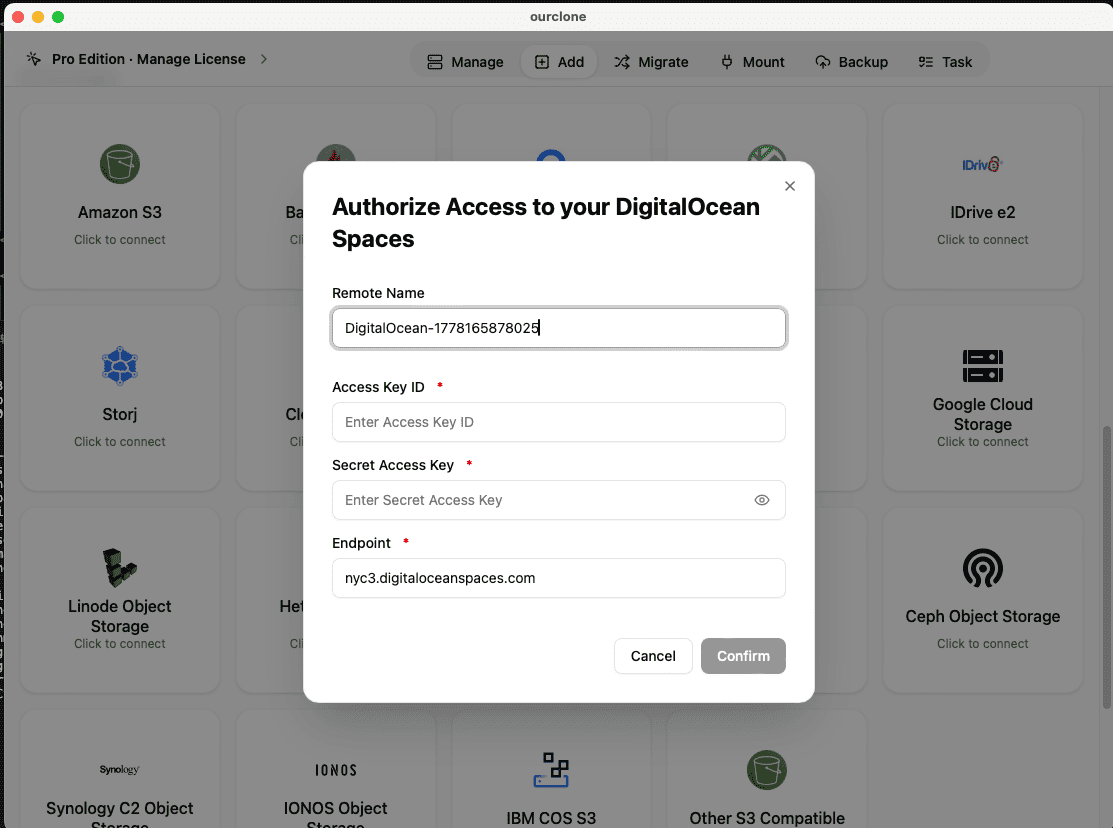
- 🔗 Add DigitalOcean Spaces in Add Storage -- In OurClone, open
Add Storageand pick DigitalOcean Spaces. Give the connection a custom name like "Spaces NYC3 -- Mac Backup", then paste your Access Key ID and Secret Access Key. Add the regional endpoint (for examplenyc3.digitaloceanspaces.com) so OurClone routes requests to the correct datacenter. Save the connection. - 📦 Create a Backup Repository in Your Space -- Open the
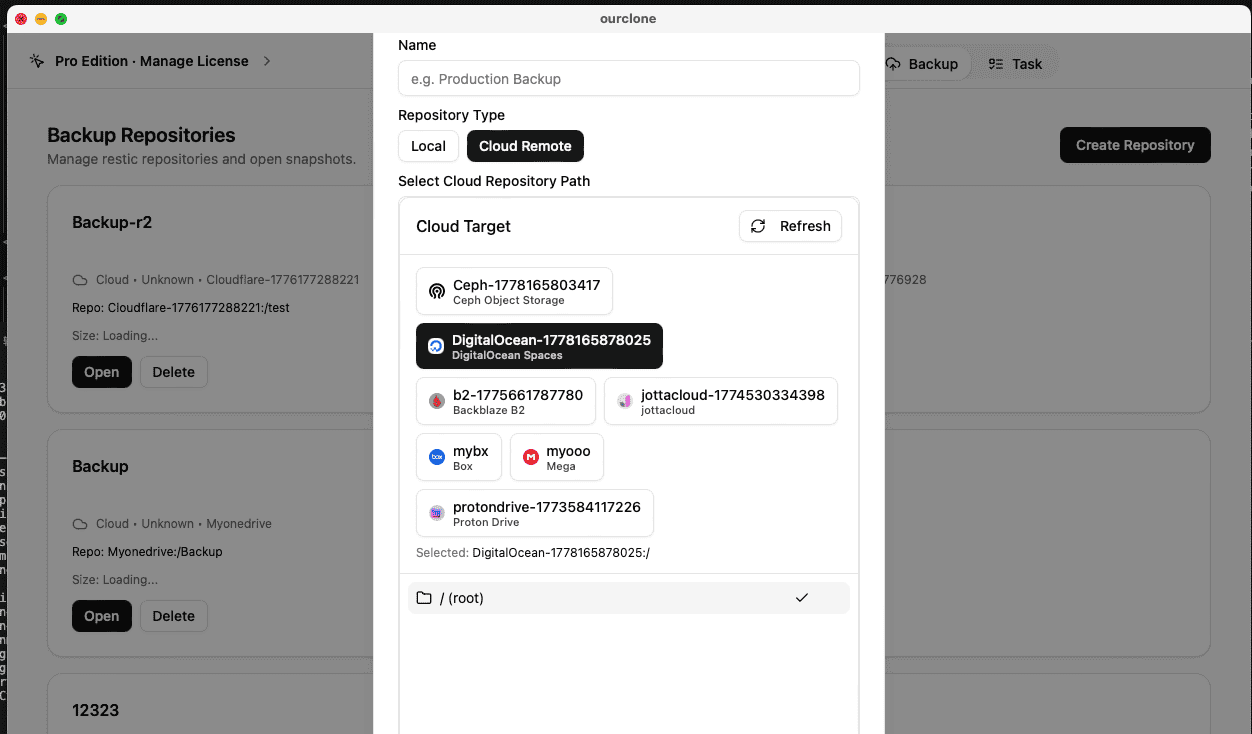
Backuptab and create a new repository. Choose your Spaces connection as the destination, point it at a path inside your Space (for examplebackups/mac-laptop), give the repository a clear name, and set a strong repository password. That password encrypts the repository and is required for every snapshot and restore -- save it in a password manager. - 🗂️ Snapshot the Folders That Matter -- Open the new repository and create a snapshot. Pick macOS folders such as
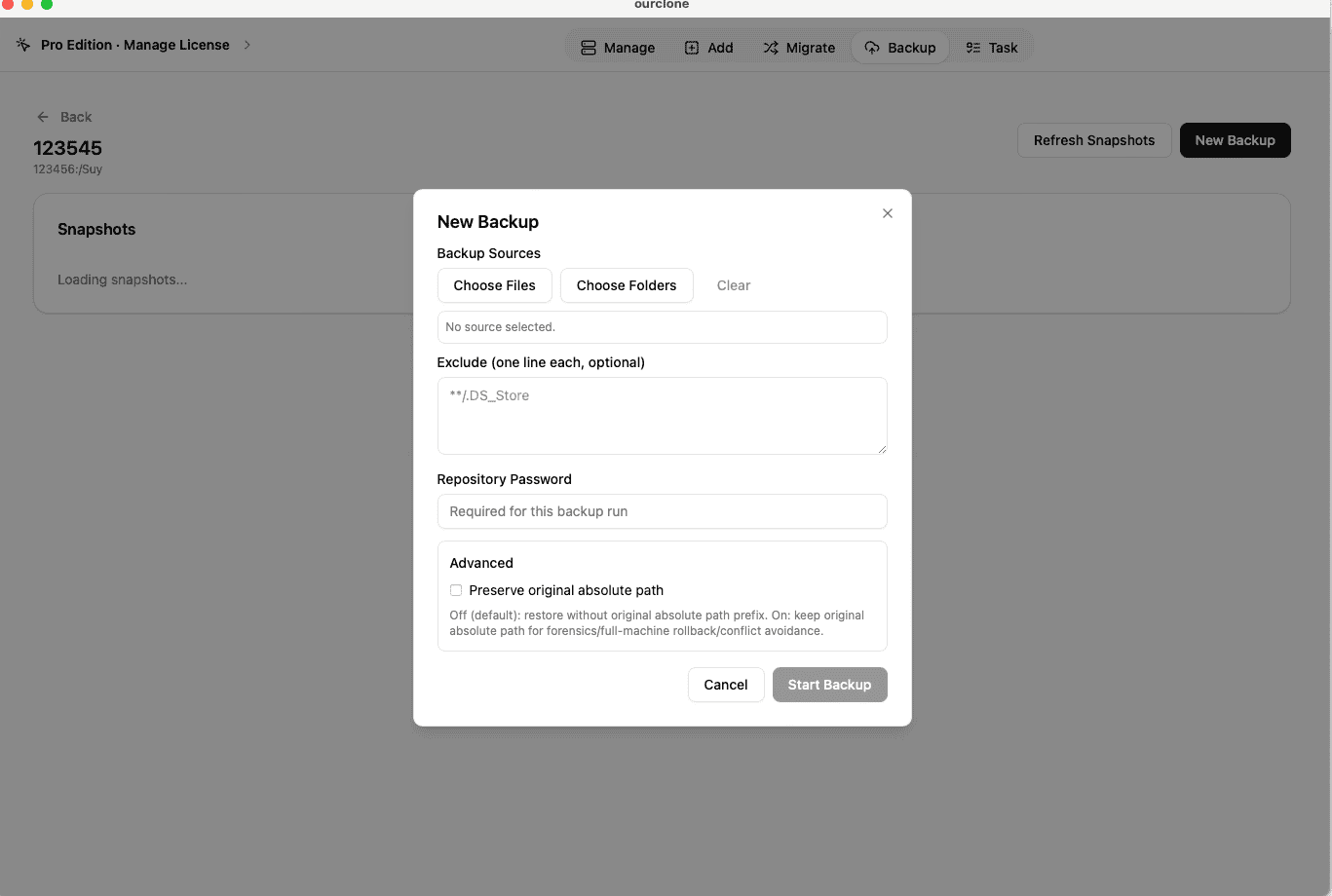
~/Documents, a working project tree, or an external drive directory. OurClone packages, encrypts, and uploads the data into your Space. The first run is a full snapshot; later runs of the same folders are incremental. - 🕒 Watch It Run From Task -- Backup & Restore -- Open the
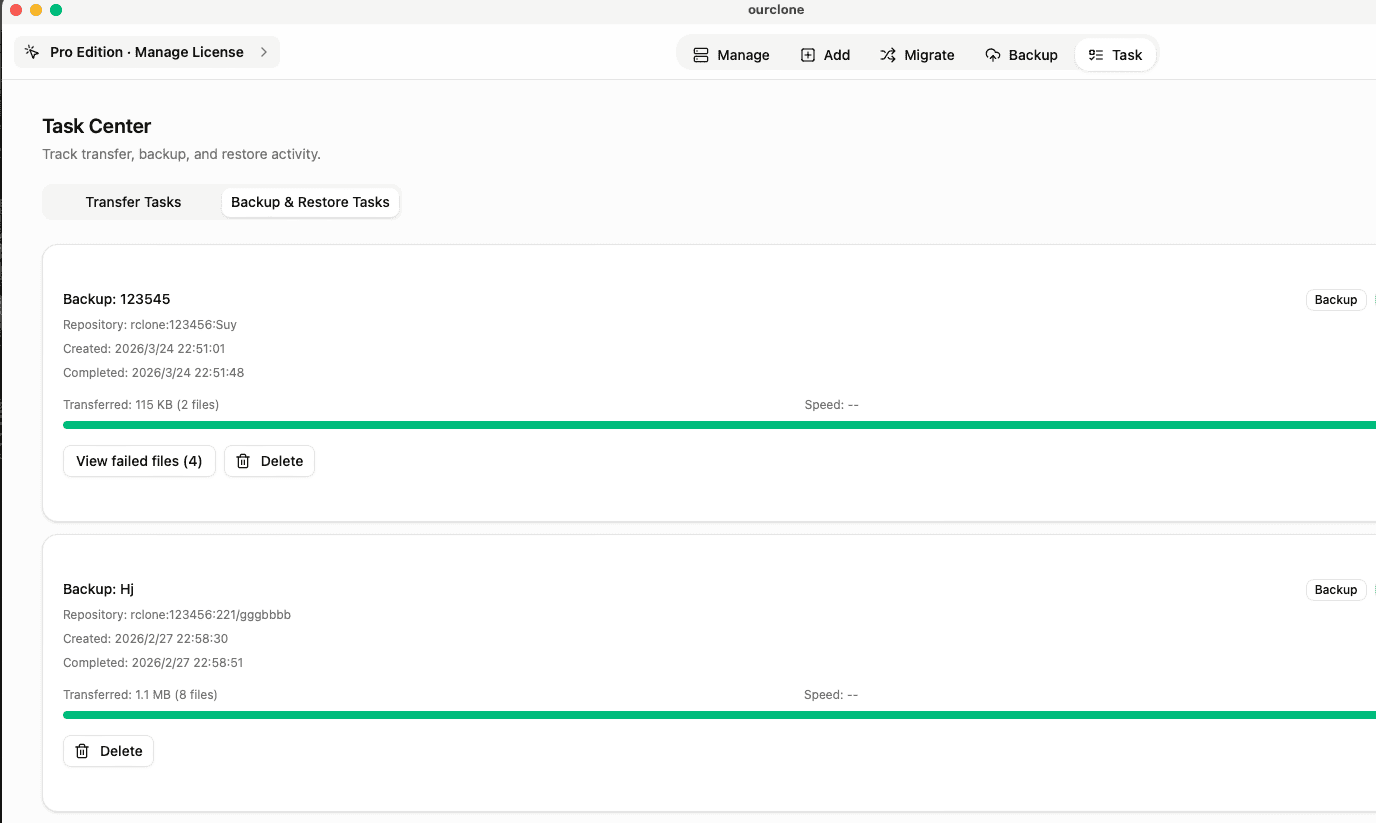
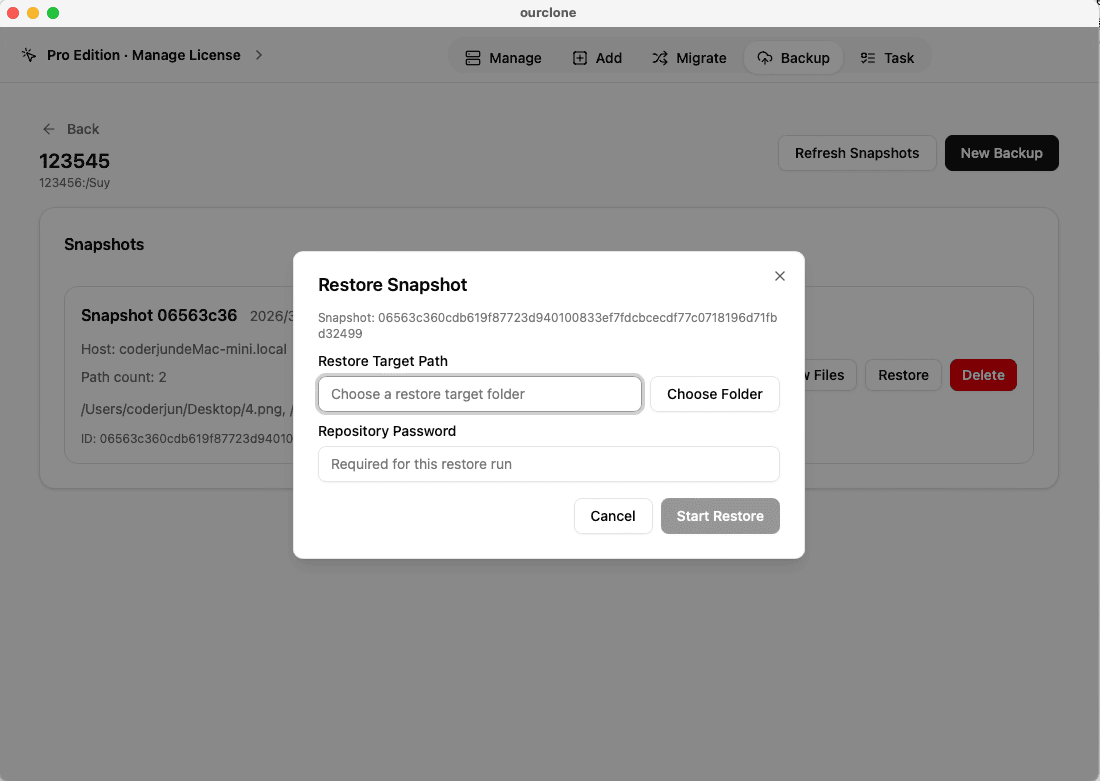
Tasktab and switch toBackup & Restore. The active Spaces task shows progress, throughput, and any warnings. Chunked uploads keep the snapshot moving even when latency to the region drifts. - 🔁 Restore From a Snapshot -- In the Spaces repository, open the snapshot you want, click
Restore, enter the repository password, and choose a local destination on your Mac. OurClone decrypts the data and writes the files back. You can restore one folder, a subset, or the whole snapshot.
Because OurClone speaks plain S3 to the Spaces endpoint, the same workflow keeps working even if you migrate the Space to a different region later -- you just update the endpoint.
Confirm Your Spaces Backup and Keep It Healthy
A short check-in routine turns a "set and forget" Spaces backup into one you actually trust.
- 📄 Check Task Status After Each Run -- In
Task->Backup & Restore, confirm the latest Spaces task finished cleanly. Repeated failures usually point at the regional endpoint or the access key. - 🧩 Read Skipped File Notes -- macOS file permissions can block OurClone from reading specific files. The task log lists which files were skipped, so you can grant Full Disk Access or move the file and re-run.
- 📜 Inspect the Detailed Log -- Open a finished Spaces task to see what was new, what was unchanged, and how much data the incremental run actually uploaded. That makes it easy to spot a folder that has unexpectedly grown.
- 🔐 Treat the Repository Password as Critical -- The Space only stores encrypted repository data. Without the repository password, even a teammate with full DigitalOcean access cannot restore.
Rotate Spaces Keys and Watch for Region Changes
Spaces keys can be rotated or revoked at any time, and Spaces themselves can be moved between regions or replaced as projects evolve. If a backup task suddenly fails, the cause is often a deleted key or an outdated endpoint. Generate a fresh Spaces key, paste it into OurClone, and update the endpoint if the Space moved.
Run a Practice Restore Before You Need One
Pick a small folder from a recent Spaces snapshot and restore it into a throwaway directory on your Mac. That single dry-run confirms the endpoint, the keys, the repository password, and the OurClone restore flow are still working together -- which is the only honest way to trust a backup you have not had to use yet.